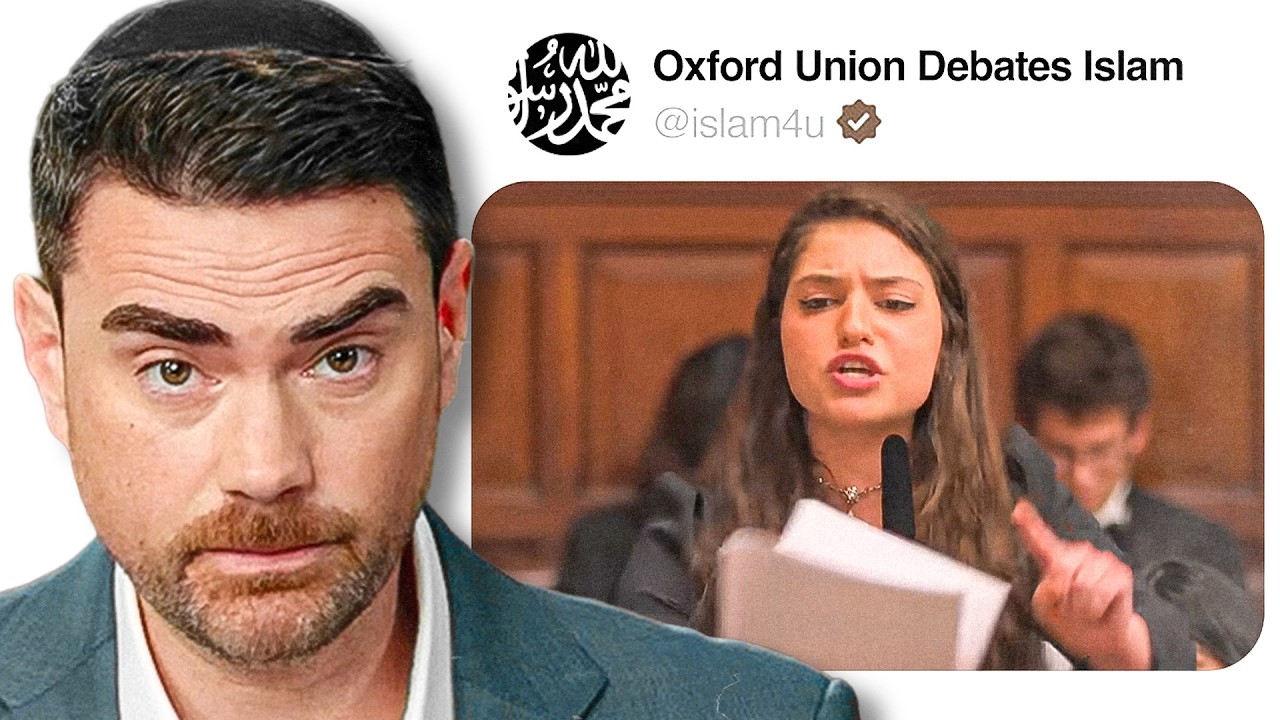
An Oxford Debate That Backfires on Its Organizers
Shapiro opens with the premise that decades of Western reassurance about Islam's compatibility with liberal civilization rest on a neoliberal fallacy: the belief that economic integration inevitably moderates ideology. He argues this logic failed even with communist China and was never going to work on radical Islam, since religious conviction, unlike economic self-interest, doesn't bend to trade incentives. Against that backdrop he introduces the Oxford Union debate on the motion "This House believes the West is right to be suspicious of Islam," noting that the motion failed but that the event required roughly eighty thousand pounds in security, with protesters linking arms to blockade access and left-wing groups like Stand Up to Racism organizing against Tommy Robinson's presence. Shapiro treats the security bill itself as ironic evidence: a debate about whether a religion is peaceful that requires a small fortune in police protection has already answered its own question. He frames the entire episode as proof that the pro-Islam side ended up making the opposition's argument for them.
"The greatest mark that your religion is a religion of peace is when it requires tens of thousands of pounds in security to prevent people from storming the place."
Churchill, Submission, and the Muslim Brotherhood's Long Game
Shapiro walks through the arguments made by the debate's proponents. Actor Laurence Fox compared Western reluctance to name Islamist extremism to Neville Chamberlain's appeasement of fascism, arguing that suspicion of a threatening ideology should be as socially acceptable as suspicion of fascism itself. Fox also stressed the literal meaning of the word Islam as submission, quoting historian Andrew Hussey's description of it as resembling a war machine more than a religion. Podcaster Jonathan Sacred then cited the Muslim Brotherhood's 1991 explanatory memorandum, seized by the FBI, which laid out a strategy of civilizational jihad through infiltrating Western institutions until, in its words, Allah's religion is made victorious over all other religions. Shapiro layers in reporting from extremism scholar Lorenzo Vidino and notes that the Trump administration designated four Muslim Brotherhood branches as terrorist organizations this year, though he faults Washington for excluding Qatar.
"Islam is a comprehensive social, political and military doctrine which leaves no part of its followers' lives untouched."
The Quiet Part Said Out Loud
The centerpiece clip features Oxford student Aisha Khan Aziz telling Tommy Robinson that without the protection of the Muslim Palestinian union president and a mostly South Asian committee, he would be, in her words, quite literally cooked. Shapiro seizes on this as an accidental admission that the supposed moderates are only holding back a violent crowd, which he says undercuts the very claim of Islamic moderation being defended. He connects this rhetorical pattern to broader European experience: riots following cartoons, and violent responses to perceived insults, framed by their perpetrators as the acceptable cost of not provoking them. He also highlights speaker Abdullah al Andalusi, a former UK government employee who once taught privately that ISIS was no different from Western armies, defending Osama bin Laden's stated grievances and arguing Islam spread historically through conquest rather than missionary work.
"You are making an argument that is the opposite of the argument that you are seeking to make."
Deflection at the Podium: Blowback, Vice, and Redefining the Question
Shapiro criticizes opposition speakers for reframing every criticism of Islam as either Western projection or a category error. One speaker, podcaster Michael Doward, argued Islam offers a wholesome alternative to drugs, pornography, alcohol, and interest banking, prompting Shapiro to note that Christianity and Judaism make similar claims without what he calls the incipient destruction of civilizations. Another speaker attributed the persecution of homosexuals in the Islamic world entirely to Western-invented categories of sexuality, a claim Shapiro rejects by citing documented abuse of boys by Afghan allies during the war, widely reported by American soldiers. He is especially pointed about Oxford Union president Arwa Al Rees, a Palestinian from Gaza, who insisted the debate concerned Islamic doctrine in the abstract rather than real-world adherents, which Shapiro says conveniently sidesteps the question of what large numbers of Western Muslims actually believe and how they behave when provoked.
"The best way to adjudicate the quality of a religion is by the adherence overall, has the religion had a positive or negative impact on the societies in which it exists."
Dearborn as a Live Case Study
Shifting to the United States, Shapiro recounts right-wing activist Jake Lang being physically attacked while preaching through a bullhorn in Dearborn, Michigan, which he calls the most Islamic city in the country, arguing that security did little to protect him as he was chased and struck. He plays audio from a Dearborn mosque commemorating the death of an Iranian leader while declaring America stolen land and invoking conspiratorial imagery about Freemasons and the Statue of Liberty. He also cites Michigan Senate candidate Abdul El-Sayed's leaked comment acknowledging that many in Dearborn mourned that same leader's death, and recalls El-Sayed's past appearance alongside a figure who described an attack on a Jewish preschool near Dearborn by saying that hurt people cause harm to others, a line Shapiro calls an ugly equivalence between a foreign militant's death and an attempted attack on Jewish toddlers.
"This guy could be in the Senate."
Electability, Identity, and the Michigan Senate Race
Shapiro closes by tying the debate back to domestic politics, noting that El-Sayed entered the final weekend before Michigan's Democratic Senate primary with a double-digit lead over Haley Stevens, according to Newsweek. He plays El-Sayed insisting that skepticism about his electability is really coded hostility toward his name and faith rather than his record, a framing Shapiro rejects outright, arguing the real objection is to his belief system and associations, not his name. He situates El-Sayed alongside sitting members of Congress he considers sympathetic to Islamist causes, including Ilhan Omar and Rashida Tlaib, and a New Jersey candidate he claims was once linked to al-Qaeda, presenting the potential election of a senator from this camp as the domestic extension of the same dynamic exposed at Oxford.
"It has nothing to do with your name, my dude. It has everything to do with your belief system."