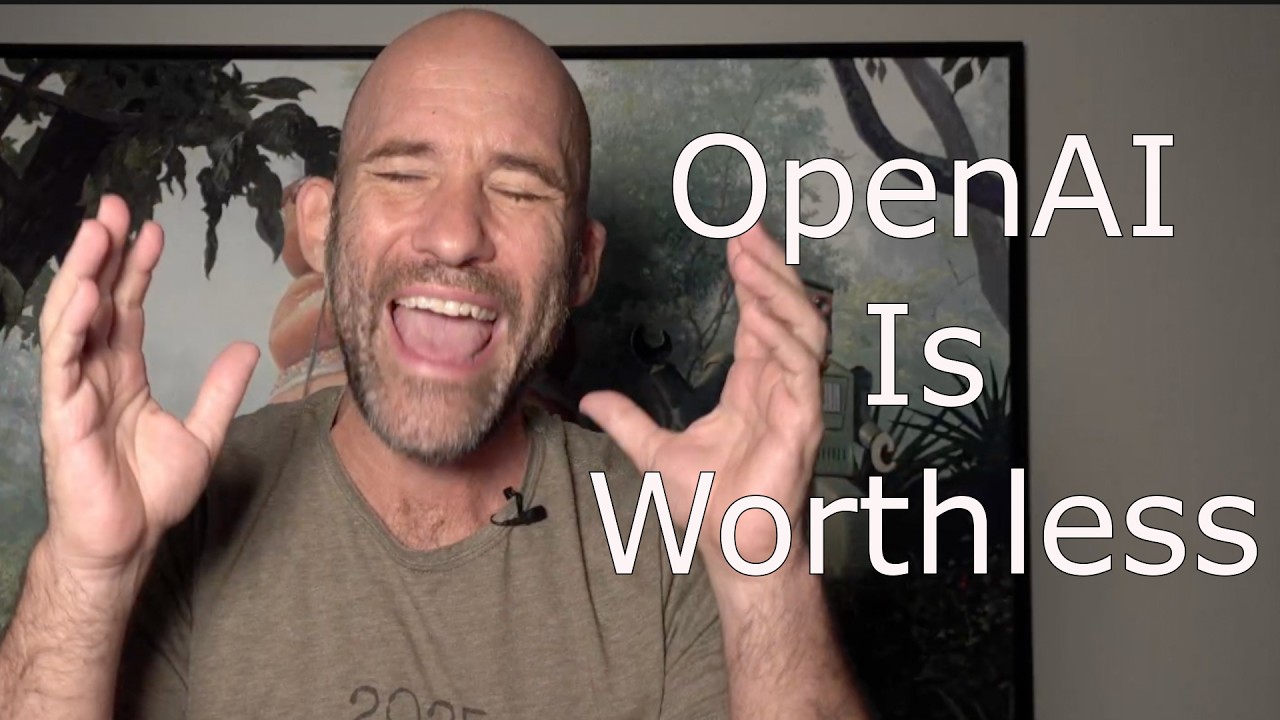
A Fire Sale Three Weeks After Launch
Eli opens with the CNBC story at the center of the episode: OpenAI has cut prices on two of its newest models, GPT-5.6 Terra and GPT-5.6 Luna, just three weeks after their public release. Terra drops 20 percent to two dollars per million input tokens and twelve dollars per million output tokens, while Luna falls a staggering 80 percent to twenty cents per million input tokens and a dollar twenty per million output tokens. Soul, the flagship model in the 5.6 lineup, keeps its price unchanged. Eli frames this not as savvy business strategy but as a symptom of desperation, a company discounting a product it just launched because customers are not convinced it is worth the sticker price.
He reads OpenAI's official explanation, that its strategy is to advance both capability and efficiency so each generation of intelligence accomplishes more work at lower cost, as corporate spin papering over a harder truth. To Eli, cutting prices this fast and this deep on freshly released models signals that demand simply is not showing up at the original price point. He calls it fire sale pricing and argues that when a company drops prices this aggressively this quickly, it is proof that people do not actually want to buy what is being sold at its intended value.
"People don't want to actually buy this crap."
Accenture's Quiet Admission and the ROI Gap
The heart of Eli's argument rests on Accenture, the global IT consulting giant that has spent the past several years pushing AI adoption onto its Fortune 500 clients. He points out that Accenture itself is now conceding that executives who deployed AI are simply not seeing a return on that investment. For Eli, this is a devastating admission precisely because of the timing: this is not 2022, when ChatGPT was new and uncertainty about AI's value was forgivable. This is 2026, years into massive capital deployment, with companies collectively investing 750 billion dollars in capex this year alone, and the customers being sold these systems still cannot articulate why they should be buying them.
He connects this directly to competitive pressure from Chinese AI startups and from Google and Microsoft, both of which have been marketing cheaper, more cost-effective models. OpenAI, in his telling, is not innovating its way to lower prices out of generosity but reacting to a market that refuses to pay a premium for unproven value. The picture he paints is of an industry-wide credibility problem, one where the promised productivity miracle has not materialized fast enough to justify the spending.
"That is a hell of an indictment for 2026."
The Trillion-Dollar Math Problem
Eli zeroes in on what he sees as an impossible equation. Sam Altman has reportedly said OpenAI needs to IPO at a trillion dollars, treating anything less as a failure. Eli takes this seriously rather than as hyperbole, noting the enormous ongoing costs of keeping data centers, GPUs, and servers running. Against that backdrop, he finds it almost absurd that OpenAI is now selling a million input tokens for twenty cents, calling the trajectory toward a trillion dollar valuation '20 cents at a time' both technically possible and financially ugly.
He does acknowledge the complicating factor of reasoning models and agentic systems, which burn through far more tokens than the old input-output structure because they add a reasoning layer and can run continuously and autonomously. Even granting that higher volume could offset lower per-token pricing, Eli remains unconvinced the math closes, and he frames OpenAI's survival past 2028 as a genuinely open question rather than a rhetorical flourish.
"You're going to get to that trillion dollar valuation 20 cents at a time."
A Lesson From His Father's Robots
To make his point about technology's value being shaped by macroeconomic context rather than pure capability, Eli tells a personal story about his father, a PhD industrial engineer whose job in the 1980s involved investigating why factory robots injured or killed workers. He describes rapid robotics development throughout that decade, only for progress to stall through the 1990s and 2000s despite no clear technical bottleneck. The explanation came from a CEO he spoke with in the early 2000s, who explained that industrial robots cost anywhere from 100,000 dollars to several million dollars, while a Chinese factory worker could be hired for about five dollars a day, making robots economically pointless in that environment.
Eli uses this to argue that technological adoption always happens inside a macro environment shaped by labor costs, demographics, politics, and war, not just raw capability. He notes that China's robotics investment is surging again now because of its aging population and shrinking workforce, a demographic cliff that makes automation economically necessary in a way cheap labor once made it unnecessary. The parallel he draws is pointed: AI's value proposition has to be measured the same way, against real alternatives like a ten-dollar-a-day virtual assistant in the Philippines, not against a hype narrative.
"Technological development is happening within a macro environment."
Betting Against the LLM-for-Everything Approach
Eli closes with what he calls one of his central arguments: that the world is on the cusp of an automation revolution, but large language models will end up being a surprisingly small piece of it. He suggests that many companies experimenting with AI will eventually realize it is far less resource intensive to build automation with relational databases and simple conditional logic than to route every process through an LLM. In his view, that realization, once it spreads, undercuts the entire premise that justifies AI's current infrastructure spending and valuations.
He leaves listeners with a direct challenge tied to the pricing news that opened the episode: if OpenAI is selling a million input tokens for twenty cents, what is actually generating a trillion dollars of value, and does anyone selling or buying these systems actually know the answer. He invites the audience to weigh in on whether OpenAI will still exist in 2028, treating that question as genuinely unresolved rather than rhetorical.
"We should automate these systems, but we're not going to automate them with LLMs cuz that's dumb."