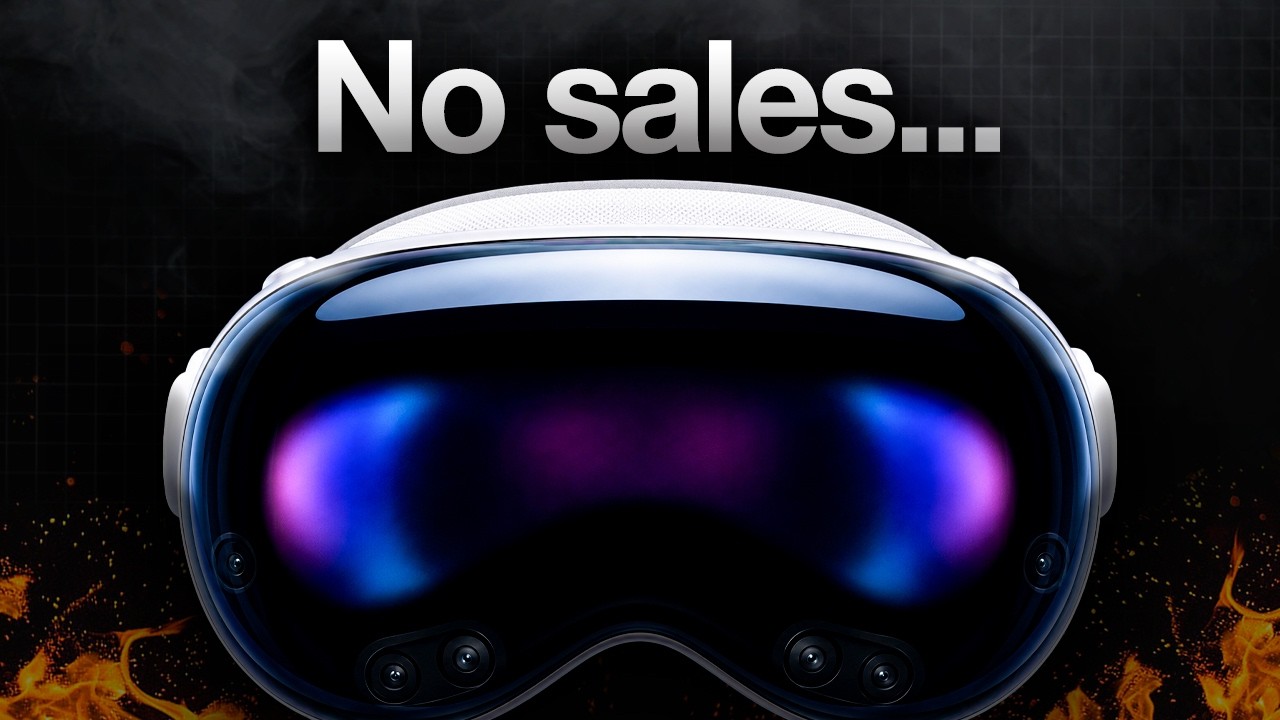
Apple's Foolproof Playbook and the One Box It Missed
The episode opens by laying out Apple's tried and true three-step strategy that powered the iPod, iPhone, iPad, and Apple Watch: enter late, polish hard, and dominate. Apple products rarely invent anything new. They arrive when competitors are already everywhere and iterate on what exists, typically at a higher price. The iPhone launched at $499 and $599 when the BlackBerry Storm cost $199. The Apple Watch started at $359, the iPad at $499. Instead of chasing mass affordability, Apple starts high, targeting luxury customers and diehard fans, then expands as production matures, always feeling more premium than rivals.
On paper, the Vision Pro fit this mold perfectly. It entered late, it iterated on existing VR technology rather than inventing it, and it offered full ecosystem integration by running iPhone and iPad apps. But Apple overlooked one crucial part of its own playbook. Every successful Apple product launched into a market with huge validation, where there were already millions of paying customers. There were smartphones before the iPhone and countless tablets before the iPad.
With VR, the situation was fundamentally different. There were plenty of products but the number of actual paying customers was tiny and niche. Even in 2026 the VR market is shrinking, falling 14% year over year, while Meta's cheaper Quest, at $500, controls roughly 80% of it. Apple entered a market that had never proven it could sustain a premium product.
"All their successful products enter late, because they have huge market validation."
A Price That Had No Market to Justify It
The second fatal flaw was the price. For decades, Apple could charge premium prices because consumers were willing to pay extra for what they perceived as the best version of a product. But that logic only works when a mass market exists to be positioned above. With the Vision Pro, that market simply was not there.
The numbers make the gap stark. The Meta Quest 3 sold for just $500, the Quest 2 dropped as low as $300, and even the premium Quest Pro topped out at $999. Apple products are usually more expensive than competitors, but nothing prepared consumers for the Vision Pro's $3,499 sticker. That made it the most expensive headset ever, by a factor of three.
The host concedes the Vision Pro could have survived as a niche Apple product, in the spirit of the Pro Display XDR. But the unit economics were so broken that even a niche existence became untenable. The price had to be high because of Apple's rulebook and the enormous costs behind it, yet that very price guaranteed it would stay a small, niche product that could never reach the volumes Apple relies on.
"This time, there wasn't a mass market for Apple to position this high."
The Economics That Turned a Product Into a Disaster
The episode digs into just how bad the financials really are. The Vision Pro launched acceptably, shipping around 390,000 units in 2024. But by the 2025 holiday season, one of the biggest spending quarters of the year, it moved just 45,000 units. For context, the Mac shipped 7.1 million units in that same quarter. The device remains available in only 13 countries, and even in the US, Apple's strongest market, stores began discounting it.
The cost structure is where things collapse. R&D estimates for the Vision Pro range from $20 to $33 billion, in line with what Meta spent, and far more than the roughly $10 billion Apple sank into its cancelled car project over fifteen years. Research firm Omdia pegged the bill of materials at $1,542, excluding R&D, packaging, and marketing. The single most expensive component is the 1.25 inch Sony Semiconductor Micro OLED display, at about $228 each, and each headset needs two.
At $3,499, the Vision Pro sells for about 2.3 times the cost of its parts, a roughly 56% gross margin that is standard for Apple. But net profit tells a devastating story. Assuming $20 billion in development spread across roughly 600,000 units sold, that works out to more than $33,000 in development cost per headset. Combined with material costs against the retail price, Apple lost on average around $28,000 per Vision Pro. In April, Apple halted production at manufacturing partner Luxshare, cut advertising by more than 95%, and killed the cheaper successor known as the Vision Air.
"So, including the material cost and the price, Apple lost, on average, $28,000 per Vision Pro."
How Meta Ray-Bans Quietly Won the Wearable Race
While Apple poured billions into a heavy computer for your face, the episode argues the real solution was something far simpler. The Meta Quest line stalled and Meta made many of the same mistakes as Apple, even while pricing low to chase developer support and market penetration. But Meta found success elsewhere by targeting everyday consumers with something they were already comfortable wearing: glasses.
The Meta Ray-Bans, built through a partnership with the world's biggest eyewear maker and released on September 17, 2025, feature a heads-up display and an integrated AI assistant that captures audio and video, processing some tasks on-device and handing others to a paired phone or the cloud. Ironically, Meta is now running Apple's own playbook: enter late, iterate, polish hard, and go premium, since both smart glasses and phones existed before. In 2025 alone, Meta sold over 7 million AI glasses after initially estimating just 2 million.
Apple noticed. On October 1, 2025, just 14 days after Meta's demo, Apple paused Vision Air production to accelerate its own smart glasses with a display. The episode frames this as a stunning role reversal. For years Apple set the direction of consumer technology and everyone followed. This time, Apple is the follower, doing exactly what Meta did, going all in on a revolutionary VR product, watching it flop, and pivoting to smart glasses.
"But this time, Apple is the follower."
A New CEO, a New Roadmap, and a Looming Privacy Reckoning
Leadership changes underscore the shift. On April 20th, Apple announced that John Ternus would become CEO on September 1st, 2026, taking over from Tim Cook. This matters because reports indicate Ternus was one of the biggest internal skeptics of the Vision Pro. He has approved a major overhaul of Apple's headset and smart glasses roadmap, which will now focus on just two smart glasses, with an unveiling potentially as early as September or October 2026.
Even so, the timing leaves Apple behind. If Apple glasses arrive around 2027, Meta's glasses will already have a multi-year head start and millions of active users. The host questions whether Apple, having fixed the one problem in its roadmap, will now simply be chasing Meta rather than leading.
The episode closes on a warning that goes beyond business strategy. These always-on AI glasses, always recording and always listening, represent what privacy experts are increasingly calling a disaster that is already happening. Unlike smartphones or social media, the harm extends not just to the wearer but to everyone around them, making the coming wave of face-worn AI a far broader societal concern than the failed Vision Pro itself.
"They're always on, always recording, always listening, and privacy experts are starting to panic."