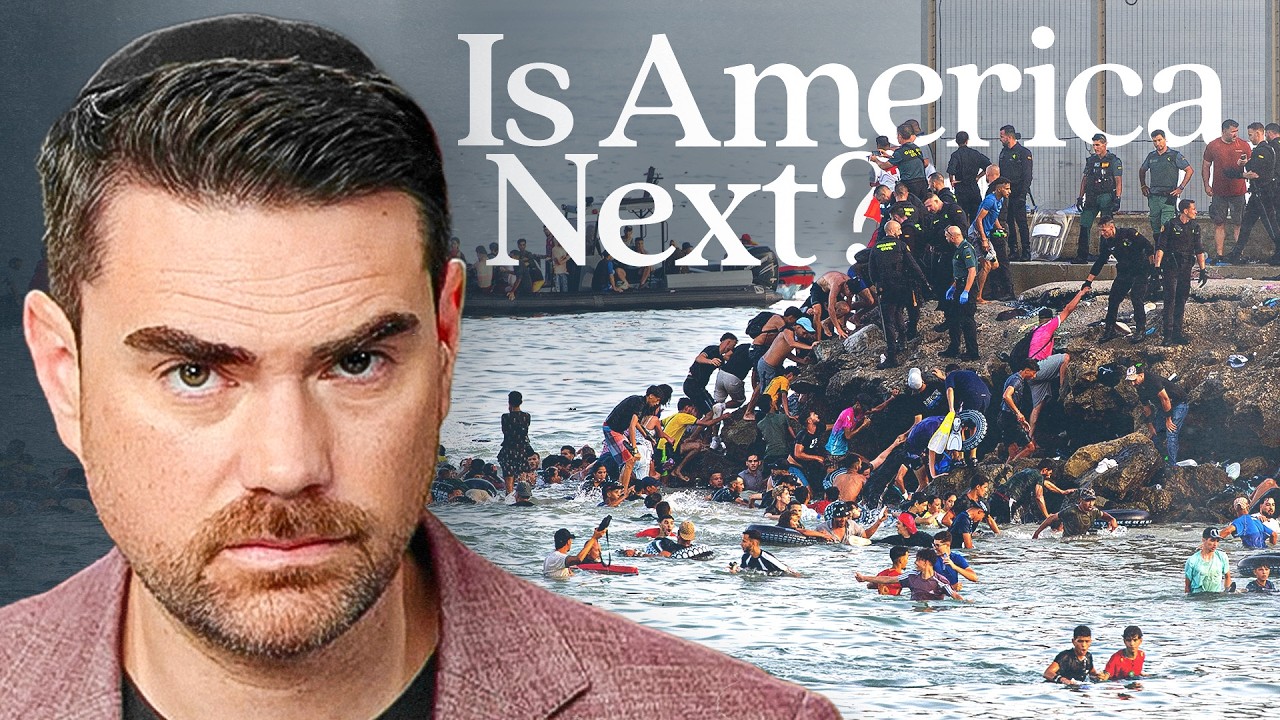
A City Doubles Overnight in Ceuta
Shapiro opens with what he calls an invasion caught on camera: footage from the Spanish enclave of Ceuta, a territory physically located in North Africa across the Strait of Gibraltar from mainland Spain. He walks through Ceuta's colonial history, from its origins under Portugal and Spain's later conquests during the Reconquista, through the 1912 Treaty of Fez that divided Morocco, up to Franco's early military campaigns against Muslim rebellions in the region. Against that backdrop he lays out the numbers, Reuters initially reported 2,000 to 3,000 crossings, but the AP later put the figure at least 60,000, against a permanent Ceuta population of only 84,000, meaning the city's population essentially doubled overnight. He stresses that multiple outlets, the New York Times and the AP, reported between 18 and 34 deaths among migrants crossing in makeshift boats or swimming around the border fence.
What strikes Shapiro most in the footage is the demographic composition of the crowd. He repeatedly notes that the people flooding onto Ceuta's beaches are almost exclusively young men, ages 18 to 34, with no women or children visible, and that Spanish police and authorities are shown opening gates and allowing them through rather than turning them back.
"This is all young working age or military age males. I mean, look at this wave of humans."
Sanchez's Amnesty and the Court Ruling That Sealed the Loophole
Shapiro identifies two structural causes behind the surge. First is Prime Minister Pedro Sanchez's April decision, confirmed by the BBC, to grant legal status to roughly half a million undocumented migrants who could prove five months of residence and a clean criminal record. Sanchez framed the move as both justice and economic necessity given Spain's fertility rate of 1.12, but more than a million people applied, nearly double the expected number, and Sanchez publicly celebrated the surge rather than treating it as a warning sign. Shapiro also cites Sanchez's February 2026 New York Times op-ed dismissing border-control arguments as the rhetoric of a collapsing society, insisting nations must choose growth over retreat.
The second cause is a July ruling from Spain's Supreme Court holding that the country's normal rule allowing immediate turnback at physical border barriers does not apply to people who arrive by sea, since the ocean is not considered a containment element. Combined with Sanchez's amnesty posture, Shapiro argues this created a functional loophole, swim or float around the fence and an administrative hearing, not deportation, becomes the default. He notes Ceuta has only two administrative courts handling about 500 cases a year each, meaning the existing backlog alone would take 60 years to clear, while migrants are released to roam freely each day and only check in nightly.
"If I swim these 10 feet around the border barrier, if I swim this 200 foot distance or take a dinghy, then that means that I get to stay basically indefinitely."
Corruption, Anti-Americanism, and a Toothless Response
Shapiro links Sanchez's rhetoric to a domestic corruption scandal he dubs the Socialist Watergate, involving Sanchez's brother David on trial for influence peddling, an investigation into former prime minister Zapatero over money laundering, and a kickback probe tied to 43 million pounds in COVID-era face mask sales. He argues Sanchez, deeply unpopular and recently ejected from power in regional elections, is using anti-Western and anti-American posturing, alliances with Maduro's Venezuela, Iran, and the Palestinian Authority, to distract from his government's failures. Spain's response to the Ceuta crisis, Shapiro notes, was sending just 200 extra police officers and 60 troops to a city already housing roughly 1,500 officers, nowhere near enough to manage 60,000 new arrivals who cannot be forcibly removed.
He contrasts this with Italy's Giorgia Meloni, who threatened to suspend Spain's participation in the Schengen open-border zone over what she called a concrete threat to European security, and with footage of Ceuta residents themselves furious, chasing migrants through their own streets and pleading, unsuccessfully, for the central government to declare a national emergency.
"The images coming from Suta are striking and demonstrate once again that uncontrolled illegal immigration poses a concrete threat to the security of Europe's borders."
Al-Andalus, Demographic Shift, and Crime Numbers in Catalonia
Shapiro places the crisis within a longer historical arc, recounting how Muslim armies conquered most of the Iberian Peninsula after 711 AD, ruling it as al-Andalus until the centuries-long Reconquista culminated in Granada's fall in 1492 and the expulsion of the Moriscos. He argues that for radical Muslims, Spain remains territory to be reclaimed, and that migration itself has become the modern vehicle for that reconquest. He cites figures showing Spain's Muslim population grew from about 250,000 in the early 1990s to 2.5 million by 2025-2026, with a million holding Spanish citizenship, concentrated in Catalonia, Andalusia, Madrid, and Valencia, and notes that about one in nine births in Spain is now to a Muslim parent, a reproduction rate he says is roughly triple that of native Spaniards.
He then turns to crime data from Barcelona, citing a report obtained by the Vox party showing Catalonia's regional police arrested nearly 22,000 people in 2024, about 80 percent of them foreign nationals, with foreigners implicated in a majority of theft cases and 73 percent of sexual assault cases. Shapiro plays a street interview in which a Moroccan migrant credits Sanchez's support for Iran and the Palestinians as the reason Muslim residents back him politically, and another clip in which a migrant complains of Islamophobia after being unable to find work, which Shapiro frames as evidence of failed integration rather than discrimination.
"He stand with Iran, with the Philistines. That's why people like it."
Merkel's Legacy and the Wider European Pattern
Zooming out to the continent, Shapiro revisits Angela Merkel's 2015 decision to open Germany's doors to mass Syrian migration, replaying her claim that Europe's connection to universal civil rights depended on accepting refugees. He counters with current demographic estimates he presents as the result: Marseille between 25 and 40 percent Muslim, Brussels 20 to 25 percent, London at least 15 percent, Amsterdam 13 percent, Paris 10 to 15 percent with 1.7 million Muslims in its metro region, and Berlin around 10 percent. He also flags a fresh U.S. State Department travel advisory for Belgium citing crime, unrest, and terrorism, presenting it as further proof of the pattern he has been describing across Western Europe.
Shapiro closes by tying the Ceuta episode directly back to American politics, arguing that the combination of an open southern border under Biden and rising Muslim political influence in cities like Dearborn and New York previews a similar trajectory for the United States if left-leaning immigration policy continues unchecked.
"It won't be the Europe we do imagine."