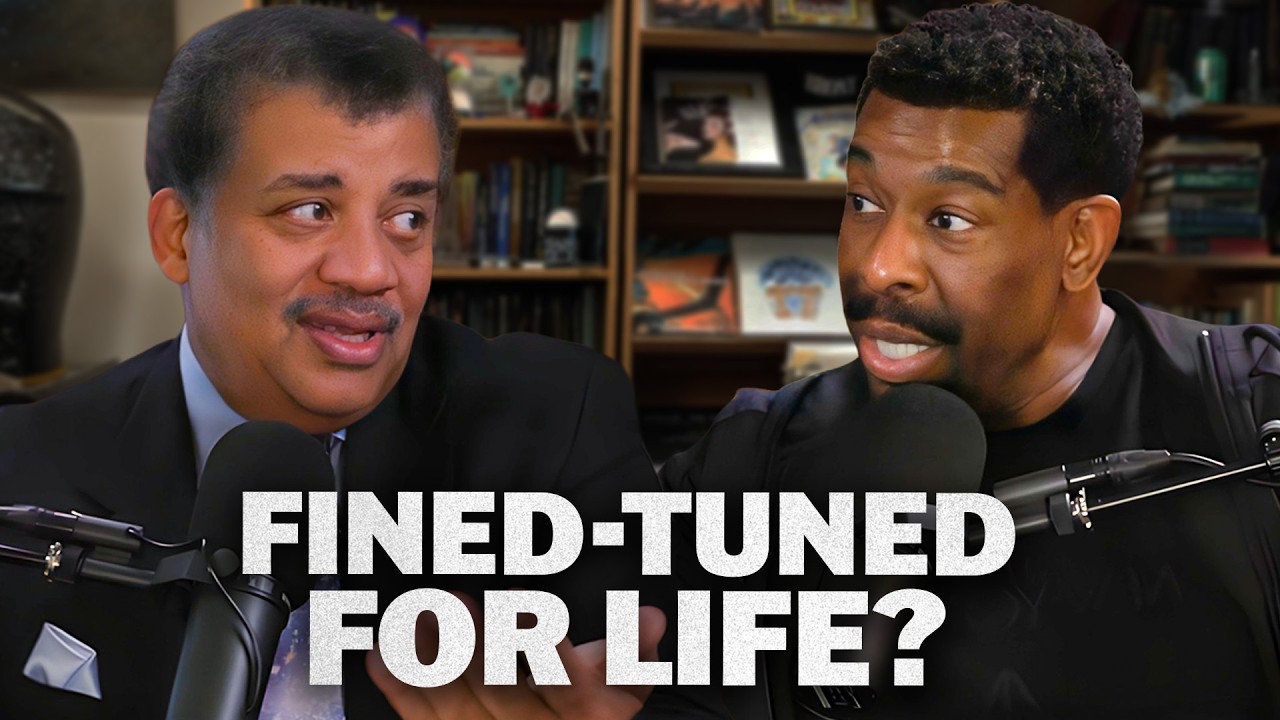
The Fine-Tuning Argument and Why the Universe Doesn't Favor Human Existence
Neil deGrasse Tyson and Chuck Nice tackle one of the most persistent arguments for divine creation: the fine-tuning hypothesis. The argument is deceptively simple—the constants of nature appear precisely calibrated to permit human existence, suggesting an intelligent designer arranged the universe specifically for us. Tyson acknowledges the surface appeal of this reasoning, conceding that if the fundamental constants of physics were even slightly different, humans would not exist. He does not argue against the mathematical reality that we observe a universe compatible with life. However, Tyson identifies a critical logical flaw buried within this seemingly compelling argument.
The flaw centers on cosmic timeline. If a creator genuinely designed the universe to favor human existence, Tyson asks, why would that creator make us wait thirteen billion years before allowing humans to appear? The universe formed in the immediate aftermath of the Big Bang, yet humans occupied an infinitesimal sliver of cosmic history. For billions of years, the universe consisted solely of gas, dust, and simple organisms—no conscious beings to observe or appreciate the creation. Most of cosmic time passed entirely devoid of human presence. Tyson emphasizes that the slow growth of structure, the prolonged cooling periods, and the violent formation of stars all consumed vast stretches of time before Earth even existed, let alone before humans evolved.
This temporal contradiction undermines the teleological interpretation of fine-tuning. If the universe were genuinely designed for us, Tyson argues, we would have shown up much earlier in the cosmic sequence. The burden of thirteen billion years of a seemingly empty universe contradicts the premise that everything was orchestrated for our benefit. The fine-tuning argument, while appearing to demonstrate design, actually reveals a universe structured according to impersonal natural processes that happened to produce conditions suitable for life—not a universe built specifically for human inhabitants. This distinction transforms fine-tuning from evidence of intentional creation into evidence of natural emergence.
"If there's such an entity that did create the universe, why make a universe where we didn't show up for 13 billion years?"
Spinoza's God and the Universe as a Single Totality
Recognizing that dismissing all conceptions of God might not fully address the philosophical and emotional dimensions of the question, Tyson introduces Spinoza's radically different approach to divinity. Spinoza proposed that God is not a conscious being who monitors behavior, listens to prayers, or enforces moral commandments. Instead, God simply is nature itself—the vast totality of the universe and all its operations. Under this definition, everything we observe, everything we feel, every natural process constitutes God. Stars, elements, motion, gravity, and light are not creations of God but manifestations of God's essence. There exists no supernatural overseer separate from nature, no personality, no will directing events according to a divine plan.
This philosophical move has profound implications for how we understand divinity and naturalism. Spinoza's conception removes the contradiction between science and faith by eliminating the competing entity that creates contradiction. There is no conflict between scientific explanation and divine intention because there is no intention beyond the operations of nature itself. Commandments, rituals, and divine judgment—the entire apparatus of traditional religion—fall away as unnecessary under this framework. God becomes a poetic way of speaking about the interconnectedness and order inherent in the universe. Many people find this conception philosophically satisfying because it preserves reverence for existence while avoiding the logical contradictions that plague traditional theology.
Yet Tyson cautions that even Spinoza's elegant solution dissolves when people revert to the traditional notion of a personal deity. When someone returns to imagining a god who monitors moral behavior, listens to prayers, or cares about human affairs, they abandon Spinoza's framework entirely and return to a conception of God that contradicts evidence. Most popular conceptions of God—the interventionist deity of conventional religion—do not withstand scrutiny when examined against what we observe about the universe. Tyson emphasizes that not all gods are philosophically equal and most collapse under careful examination. The distinction matters because it clarifies what we are actually defending when we defend belief in God—a personal, interventionist deity faces genuine logical problems, while Spinoza's naturalistic conception simply redefines terms without addressing the scientific understanding of reality.
"I don't have an argument against the fact that we have constants of nature that if they were slightly different we wouldn't be here."
Mystery as Invitation Rather Than Sacred Territory
Central to Tyson's perspective is a fundamentally different approach to unknowns and mysteries. Rather than treating the unknown as sacred territory that science should approach with reverence or caution, Tyson presents mystery as an invitation to investigate. Dark matter and dark energy provide contemporary examples of this principle in action. These phenomena comprise most of the universe by mass-energy, yet physicists do not currently understand what they are. No one questions their existence because their gravitational effects are directly measurable and reproducible. Scientists do not invoke God to explain dark matter simply because they cannot yet fully characterize its nature. Instead, they design experiments, build better instruments, and continue the investigation.
This contrasts sharply with the approach of treating mystery as evidence for the supernatural. When people encounter something they cannot explain, they face a choice: treat it as a temporary puzzle awaiting solution through continued inquiry, or treat it as sacred territory that permanently resists explanation and therefore proves divine authorship. History demonstrates that the first approach—treating mystery as an invitation to investigate—has proven vastly more productive. Scientific understanding of the natural world has advanced precisely by refusing to accept mystery as permanent and inviolable. Every phenomenon that was once treated as obviously divine—weather, disease, heredity, consciousness—has yielded to scientific investigation and now possesses natural explanations grounded in mechanism and cause.
Tyson argues that ignorance is temporary when inquiry continues, but people who rush to label the unknown as sacred effectively shut down the very process that could provide answers. This represents a profound difference in epistemology—how we decide what counts as knowledge and what method we use to find it. Science does not claim to have answered every question or explained every phenomenon, but it provides a methodology for progress that has proven spectacularly successful. Treating mystery as an opportunity rather than a barrier opens the frontier of the unknown to exploration without superstition. This approach transforms fear of the unknown into curiosity about it, shifting our relationship with the universe from one of awe before the incomprehensible to one of wonder before the not-yet-understood.
"Each time science explains a phenomenon, that deity retreats."